The FTC Fake Reviews Rule: What Shopify Stores Must Know
What the FTC fake reviews rule bans, what it allows, and a pre-publish checklist for Shopify stores, including imported supplier reviews. Sourced to ftc.gov.
The FTC's rule on fake reviews has been in force since October 21, 2024, and in December 2025 the agency sent its first batch of warning letters under it. If you run a Shopify store, FTC fake reviews enforcement comes down to one idea: every review you show, buy, solicit or display has to reflect a real customer's real experience with the product on the page. The rule bans fake and AI-invented reviews, paying for positive ones, undisclosed staff reviews, and intimidating people into deleting negative reviews. Courts can impose civil penalties for knowing violations.
This guide translates the rule into store operations, quotes the regulation directly, and covers a question the law-firm alerts skip: what to do with reviews you import from a supplier listing or marketplace (the case we built Gather Reviews for).
FTC fake reviews rule: what it bans, in six bullets
The official name is the Trade Regulation Rule on the Use of Consumer Reviews and Testimonials (16 CFR Part 465). According to the FTC's announcement of the final rule, it prohibits:
- Fake reviews and testimonials. Reviews that misrepresent that they are by someone who doesn't exist, "such as AI-generated fake reviews," or by someone who didn't have actual experience with the product.
- Buying reviews with strings attached. Compensation or incentives "conditioned on the writing of consumer reviews expressing a particular sentiment."
- Undisclosed insider reviews. Reviews by officers, managers and, in some cases, employees and their relatives, without a clear disclosure of the relationship.
- Fake "independent" review sites. Presenting a site you control as an independent source of reviews for your product category.
- Review suppression. Using groundless legal threats, intimidation or false accusations to stop or remove a negative review, and misrepresenting your on-site reviews as complete when you're hiding negative ones.
- Fake social influence. Buying or selling fake followers, views or other indicators generated by bots or hijacked accounts.
When it took effect and who it covers
The rule was published in the Federal Register on August 22, 2024 (89 FR 68034), and the FTC's Consumer Review Rule Q&A confirms it "went into effect on October 21, 2024." The same page says the rule "authorizes courts to impose civil penalties for knowing violations."
Who it applies to is broad. The regulation defines a business as "an individual who sells products or services," a partnership, a corporation, "or any other commercial entity that sells products or services." There's no revenue threshold, so a solo dropshipper is covered. The Q&A adds that agencies, review brokers and reputation-management firms can be liable too, while "ordinary consumers can't be liable under the rule" for what they write.
The rule sits on top of the FTC's older Endorsement Guides (16 CFR Part 255), which still apply. The Guides are where the broader "don't distort what customers think" principle lives, and that matters for imported reviews later on.
Banned practice 1: fake reviews, AI-written or misattributed
Section 465.2 bars a business from writing, creating or selling a review that "materially misrepresents, expressly or by implication":
- that the reviewer exists,
- that the reviewer "used or otherwise had experience with the product," or
- the reviewer's actual experience.
It also bars buying reviews the business "knew or should have known" were false. The Q&A gives concrete red flags that should put you on notice: reviews that "appear so quickly after purchase that it's doubtful they reflect real experiences," "an unusually large number of reviews" in a short window, or reviews that "refer to the wrong product."
In a store, that means: no asking a chatbot for "ten realistic five-star reviews," no writing reviews under customer-sounding names, no review packages that deliver dozens of glowing reviews overnight, and no rewording a real three-star review into a five-star one (the reviewer exists, but their experience is now misrepresented).
On AI specifically, the Q&A is careful: there's "no blanket prohibition on the use of AI-generated avatars in marketing." The problem is fake content, not the tool. Using AI to summarize or translate real reviews is a different question from using it to invent them, but any summary still has to reflect what reviewers actually said.
Banned practice 2: buying reviews or tying rewards to sentiment
Section 465.4 makes it unlawful "to provide compensation or other incentives in exchange for, or conditioned expressly or by implication on, the writing or creation of consumer reviews expressing a particular sentiment, whether positive or negative."
The words "by implication" do a lot of work. The Q&A says "you can't suggest to consumers that their reviews must be positive" to get the reward. Incentives aren't banned outright. They're fine when "there isn't an express or implied requirement that the reviews have to express a particular sentiment."
| Request | Likely read | Why |
|---|---|---|
| "Leave a review of your order and get 10% off your next one." | Generally fine | Reward doesn't depend on the rating |
| "Loved it? Leave us 5 stars for 10% off!" | Problem | Implies the reward is for a positive review |
| Review-request email sent only to customers who rated support 9–10 | Problem | The Endorsement Guides Q&A says asking only customers likely to be happy "would be misleading" if it skews the reviews |
| Free product to a "review club" that's told to post within 24 hours | Risky | Matches the FTC's "should have known" red flags |
If you want more honest reviews without these traps, our guide on how to get customer reviews on Shopify walks through timing, email flows and neutral incentive wording.
Banned practice 3: insider reviews without disclosure
Section 465.5 targets reviews from inside the business. An officer or manager can't write a review of the business's products without "a clear and conspicuous disclosure" of their relationship. Managers also can't ask employees, agents or relatives to post reviews when the result is undisclosed reviews and the manager encouraged them not to disclose, didn't tell them to disclose, or knew and didn't fix it.
The rule defines "immediate relative" as a spouse, parent, child or sibling, and treats owners and executives as officers. The Q&A notes that "agents" include ad agencies, PR firms and review-management firms.
There's a practical carve-out: a generalized review request sent to all purchasers doesn't trigger the insider rules just because a staff member happened to buy the product and received the email.
For a small store the fix is simple: no product reviews from your co-founder, cousin or VA. If a team member wants to share an opinion, label it clearly ("From our team") and keep it out of the customer review feed.
Banned practice 4: suppressing or hiding negative reviews
Section 465.7 has two parts.
Threats and intimidation. Nobody may use "an unfounded or groundless legal threat, a physical threat, intimidation, or a public false accusation" to stop a review being written or to get one removed.
Hiding negative reviews on your own site. A business may not misrepresent that the reviews shown in its review section "represent most or all the reviews submitted" when reviews "are being suppressed (i.e., not displayable) based upon their ratings or their negative sentiment." You can withhold reviews for neutral reasons applied to every review regardless of rating: abusive or obscene content, other people's personal information, content that's "clearly false or misleading," reviews you reasonably believe are fake, or reviews "wholly unrelated" to your products.
Sorting is a gray zone. The Q&A says a default sort with five-star reviews on top isn't covered by the rule, but warns that organizing reviews "in a way that makes it difficult for consumers to know about or find negative reviews" could still violate Section 5 of the FTC Act. The Endorsement Guides Q&A goes further and calls a strict 5-to-1-star default order a "misleading picture." Newest-first is the safer default.
Repurposing reviews across products: why "identical product" is the line
Review hijacking means showing reviews written about one product on a different product's page. The FTC proposed a specific ban (it would have been Section 465.3), but that section is marked "[Reserved]" in the final rule. According to the final rule notice, commenters raised concerns about how to define a "substantially different product," and the Commission decided not to finalize the provision because it couldn't resolve those concerns on the rulemaking record.
That doesn't make hijacking safe. In 2023 the FTC brought what it called its first case alleging review hijacking under its general authority. A supplement company had used Amazon's variation feature to attach reviews of established products to new ones with different formulations. The settlement included a $600,000 payment. And under Section 465.2, a review attached to the wrong product arguably misrepresents that the reviewer "had experience with the product" on the page.
So the workable line for a store is the identical product: same item, same specification. Not a different colorway with a different material. Not "basically the same" from another factory. Not last year's version.
Imported and syndicated reviews: a safe-practice checklist
Many Shopify merchants, especially dropshippers, sell an item that is also listed on AliExpress or Amazon with hundreds of buyer reviews. Showing some of those reviews on your own product page is common. The FTC rule doesn't mention imported reviews by name. That isn't permission, though. It means the general prohibitions apply, and two lines from the Endorsement Guides do most of the work:
- An endorsement "may not be presented out of context or reworded so as to distort in any way the endorser's opinion or experience" (16 CFR 255.1(b)).
- In "procuring, suppressing, boosting, organizing, publishing … or editing consumer reviews," advertisers "should not take actions that have the effect of distorting or otherwise misrepresenting what consumers think of their products" (16 CFR 255.2(d)).
Put together with Section 465.2, these add up to five checks for every imported review:
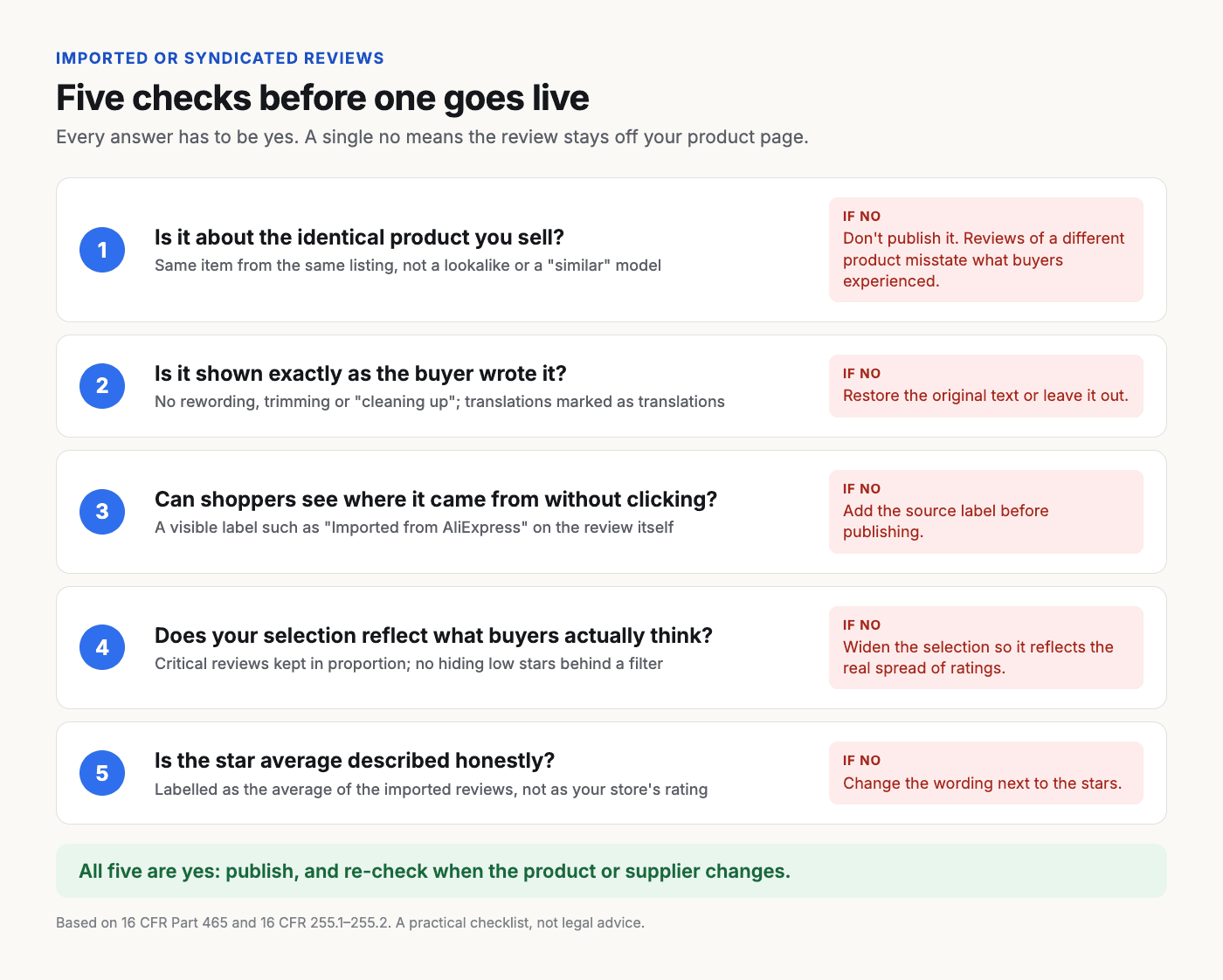
A few specifics that trip stores up:
- The label has to be visible without clicking. The rule's definition of "clear and conspicuous" says a disclosure isn't adequate "if a consumer must take any action, such as clicking on a hyperlink or hovering over an icon, to see it." A tooltip doesn't count; a line of text on each review does.
- Star filters can distort. Importing only the 5-star reviews from a listing that averages 3.9 turns real buyers' words into a misleading picture, even though every single review is genuine. Import across the rating range. If you do narrow the selection, the average you show must say what it is: the average of the selected reviews, not the listing's or your store's rating.
- Your store rating is a separate thing. Imported reviews describe the product as bought on another platform. They say nothing about your shipping, packaging or support. Keep them out of your store-wide rating. Google's review snippet guidelines also say "Don't aggregate reviews or ratings from other websites," so leave them out of your rating markup too.
- Re-check when things change. A supplier switch, a new mold or a material change can quietly turn "identical" into "similar." Remove the imported reviews when that happens.
- Check the source's terms. FTC compliance and platform terms are separate questions. Read the source marketplace's terms before you import anything.
What the December 2025 warning letters signal
On December 22, 2025, FTC staff sent warning letters to 10 companies about possible violations of the rule. The FTC's business blog post on the letters highlights two behaviors: using fake reviews and "providing money or incentives for only positive reviews." It also notes that civil penalties can reach "up to $53,088 per violation," which "can quickly add up."
The signal for store owners is that enforcement started with the basics: fake reviews and rewards for positive reviews, the two most common shortcuts small stores take. Penalties are assessed per violation, and the FTC itself warns that they can quickly add up. If any current review flow depends on "5 stars = reward," change it now.
Pre-publish review compliance checklist
Run this before you launch a review flow or publish a batch of reviews. You can also download the checklist as a text file to share with your team or VA.
Every review
- Written by a real person who bought or used this product. Nothing AI-invented, staff-written or bought from a review seller.
- Shown in the reviewer's own words; translations are labelled as translations.
- No owner, manager, employee, agent or relative reviews without a clear disclosure.
- No incentive tied, openly or by hint, to a positive rating.
How you ask
- Requests go to all buyers (or a neutral sample), not only happy ones. The FTC calls asking only likely-happy customers misleading when it skews the reviews.
- Any reward is offered for an honest review of any rating.
How you display
- Negative reviews are published on the same terms as positive ones.
- You only withhold reviews for neutral reasons applied to every review (abuse, personal data, obvious fakes, unrelated content).
- The default sort doesn't bury low ratings.
- You never pressure or threaten customers to remove reviews.
Imported or syndicated reviews
- The source listing is the identical product you sell.
- Every review shows a visible source label and unedited text.
- Your selection reflects the real spread of ratings. If your import tool has a minimum-star filter, set it to all ratings.
- The star average is described as the imported reviews' average, not your store's rating.
- You re-check the match whenever the supplier or product changes.
How Gather Reviews builds in these guardrails
We built Gather Reviews for the imported-review case above, and the rule shaped the product more than any feature request did. It imports reviews from the AliExpress listing you source a product from (all plans) or the Amazon listing (paid plans). You filter them by stars, photos and language, preview them, and publish the ones you choose. A few decisions are there on purpose:
- Identical-product confirmation. Before fetching anything you must tick "This listing is the same product I sell." The app won't import without it, and the review screen repeats that reviews of a similar or different item can mislead shoppers.
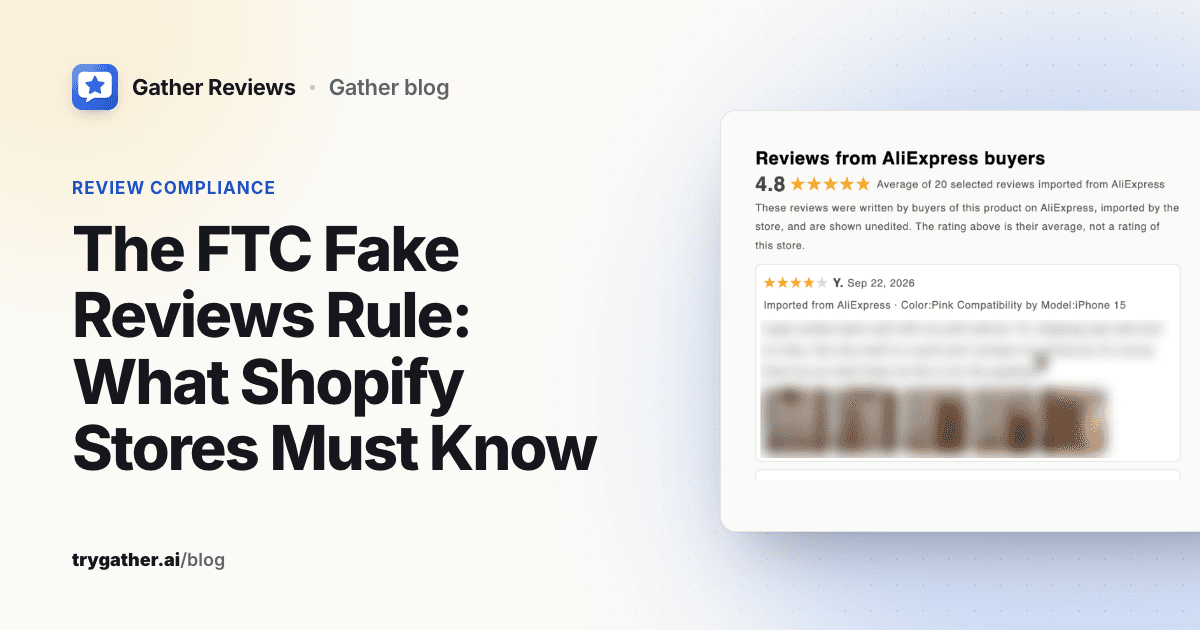
- Source labels on every review. Each review shows "Imported from AliExpress" or "Imported from Amazon" as visible text. By default the reviews block is headed "Reviews from AliExpress buyers" (or Amazon buyers). Merchants can rename the heading but can't remove the disclosure.
- Unedited text. Reviews are published as written. Marketplace-supplied translations are labelled, with the original one click away by default.
- An honest average. The reviews section reads "Average of N selected reviews imported from AliExpress," followed by a disclosure that the rating "is their average, not a rating of this store." The compact star-rating line under the product title names the source ("20 reviews from AliExpress").
- No store-rating mixing. The app doesn't write Shopify's standard product rating fields, so imported stars don't flow into your store's own rating data.
- Amazon acknowledgement. A one-time confirmation is required before the first Amazon import.
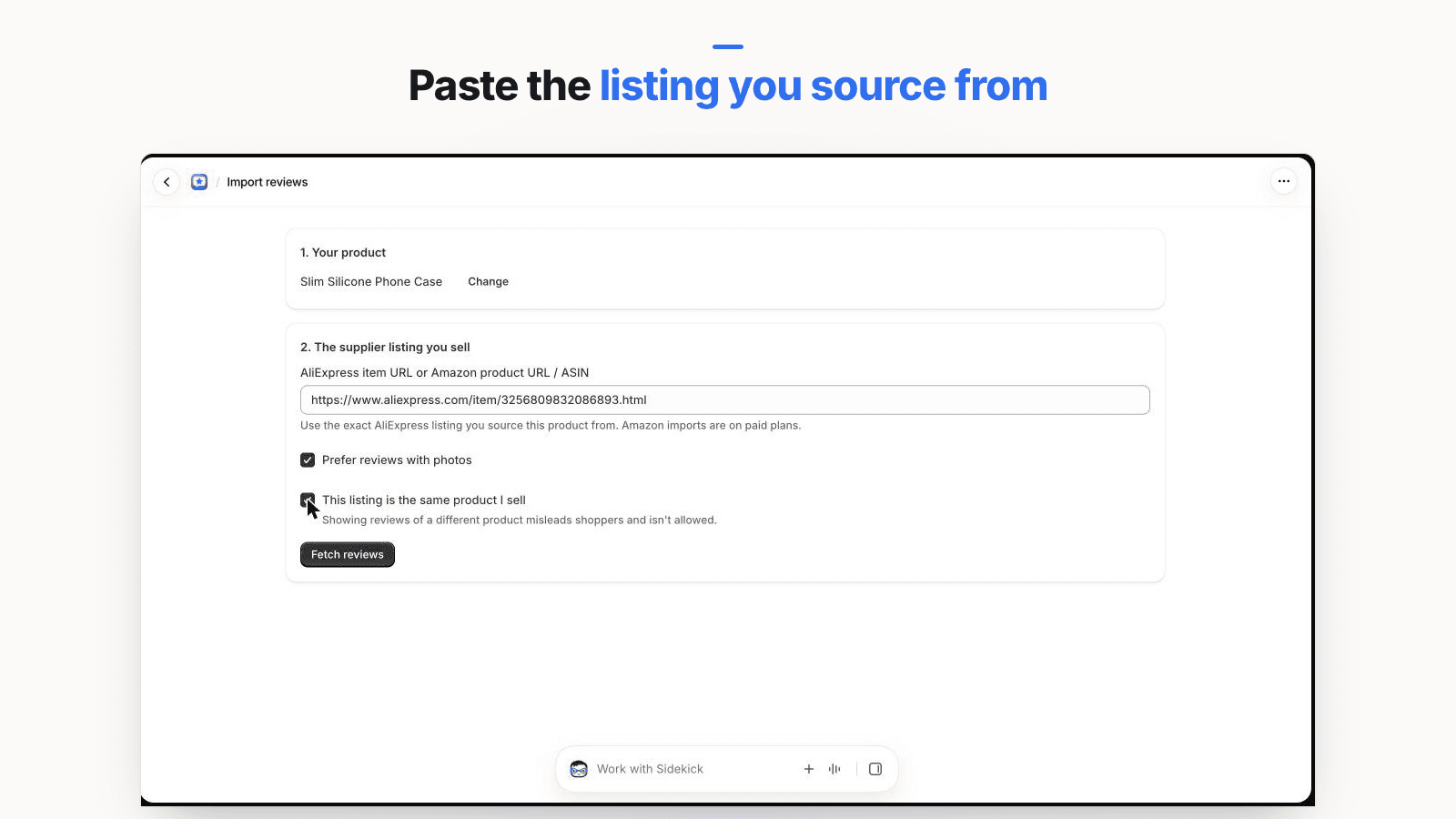
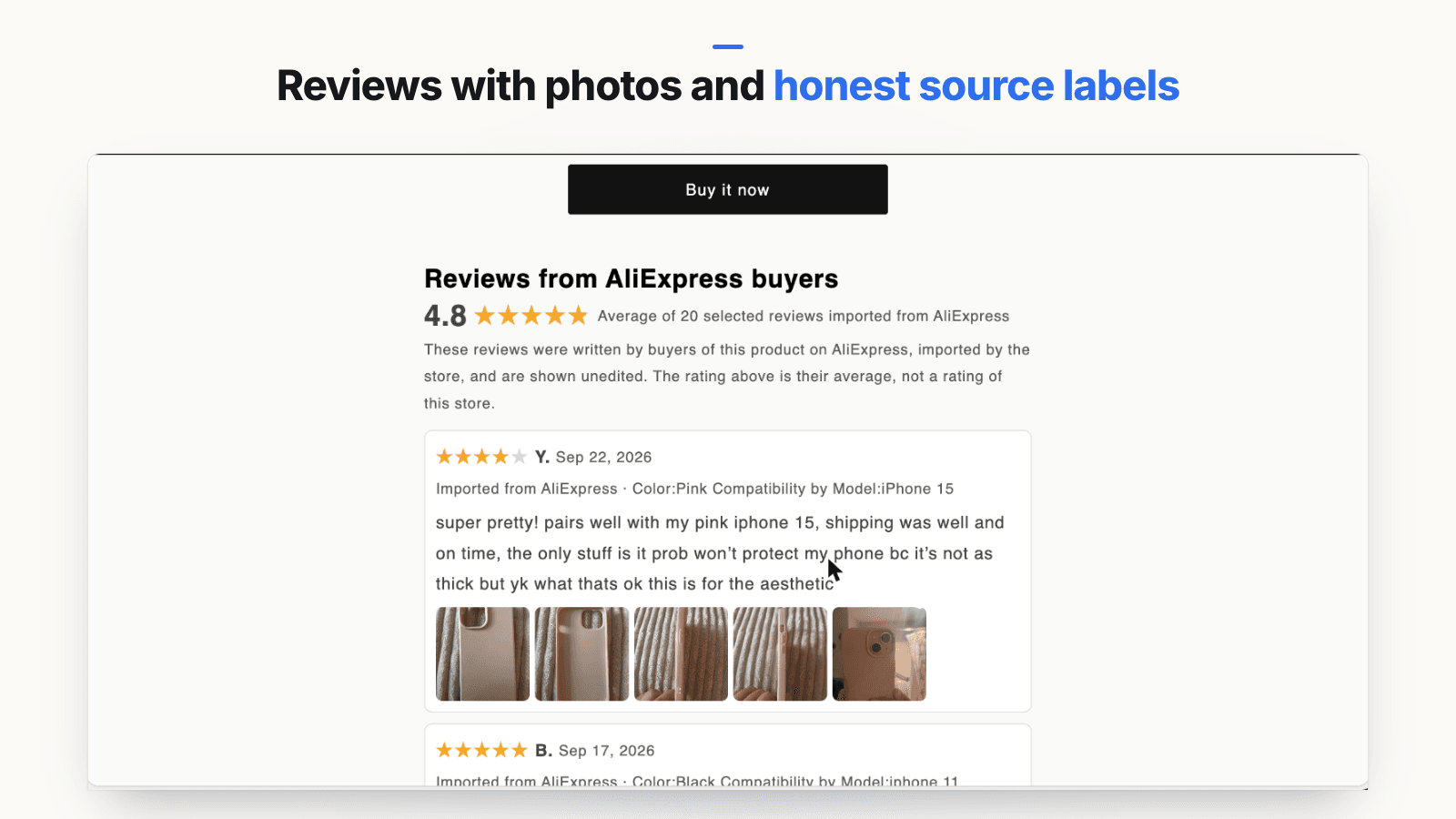
Two honest caveats. First, the import screen still lets you filter by minimum star rating. It defaults to "All ratings" and shows a warning when you raise it, because leaving out 1- to 3-star reviews is exactly the kind of selection 16 CFR 255.2(d) warns can distort what buyers think. Use the photo and language filters instead if you want to trim the batch. The reviews section always says "selected" and always shows the disclosure, but a label doesn't fix a lopsided selection. Second, no app can make you compliant. Whether a listing is truly identical, and whether a given selection is fair, is your call. Gather Reviews is new and is being submitted to the Shopify App Store now.
The manual alternative works too: add reviews by hand in any review app that supports visible source labels, and apply the same five checks. It's slower, and labels tend to slip. For a broader look at review tools and native options, see how to add reviews to Shopify. If you're launching with zero reviews, social proof for a new Shopify store covers honest options that don't rely on reviews at all.
Frequently asked questions
What is the penalty for fake reviews under the FTC rule?
The rule lets courts impose civil penalties for knowing violations. In its December 2025 warning letters the FTC said penalties can reach up to $53,088 per violation. That cap is adjusted for inflation, so check ftc.gov for the current figure. Penalties are assessed per violation, and the FTC warns they can quickly add up.
Does the FTC rule apply to small Shopify stores?
Yes. The rule defines a business as any individual or company that sells products or services, with no size threshold. A one-person dropshipping store is covered the same way a large retailer is. Ordinary shoppers who write reviews are not liable under the rule.
Can I offer a discount in exchange for a review?
You can offer an incentive for a review as long as it is not conditioned, openly or by implication, on the review being positive (or negative). Offer the same reward for an honest review of any rating, and don't hint that five stars is expected.
Is it legal to import reviews from AliExpress or Amazon?
The FTC rule does not address imported reviews by name, and this article is not legal advice. What the rule and the Endorsement Guides do prohibit is misrepresenting who wrote a review, whether they used the product, or what consumers think overall. If you show supplier reviews at all, limit them to the identical product, keep the text unedited, label the source on every review, avoid selections that distort the overall picture, and check that the source platform's own terms allow it.
How do I report fake reviews to the FTC?
Report suspected violations at ReportFraud.ftc.gov. For reviews on a marketplace such as Amazon, also use that marketplace's own reporting tools.